
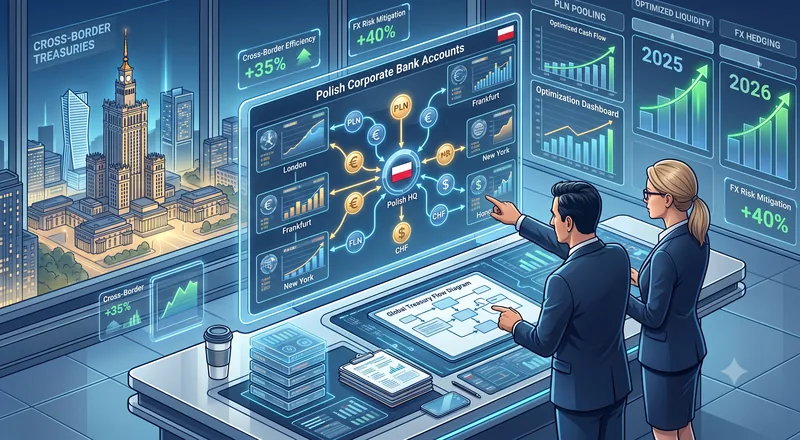
Optimizing Polish Corporate Bank Accounts for Cross-Border Treasuries
Establishing a resilient corporate presence in the Polish market demands a flawless treasury setup. Cross-border treasurers face compliance layers that dictate exactly how daily operations run. Ignorance of these statutory mechanisms leads directly to frozen funds and severe financial penalties. You must align your corporate governance precisely with local expectations to maintain uninterrupted liquidity.
In 2026, the regulatory framework governing Polish corporate banking reached unprecedented levels of digital integration. The National e-Invoice System (KSeF) mandate fundamentally altered how businesses process their accounts payable. Simultaneously, the Polish tax authorities deploy real-time monitoring tools to track corporate capital flows. Treasurers must adapt their workflows to survive in this highly scrutinized environment.
Requirements for Board Member Identity Verification
Polish banks legally require all corporate board members to undergo strict identity verification, involving a valid passport, proof of residential address, and ideally an active PESEL number, before activating a corporate account.
In our practice tracking CEE markets, we consistently see that identity verification remains the primary bottleneck for foreign executives. Polish financial institutions enforce rigorous Anti-Money Laundering (AML) standards. They refuse to activate accounts until every Ultimate Beneficial Owner (UBO) and board member clears a background check. You cannot bypass this step by relying solely on foreign notaries.
Unpacking the Ultimate Beneficial Owner (UBO) Registry
Bank compliance officers look far beyond the immediate board of directors. They trace the entire corporate structure up to the Ultimate Beneficial Owner. Polish law mandates that any individual controlling more than 25% of the entity undergoes intense scrutiny. You register these individuals in the Central Register of Beneficial Owners (CRBR) within seven days of incorporation.
Document Legalization and Sworn Translations
Presenting foreign corporate documents requires careful administrative preparation. Financial institutions routinely reject plain copies of foreign business registry excerpts. You secure an Apostille for every corporate document originating outside Poland to prove its authenticity. Additionally, Polish banks demand sworn translations for any document not drafted in Polish or English, executed strictly by a certified translator.
Handling High-Risk Jurisdictions
Citizenship heavily influences the speed of your banking application. Directors holding passports from countries flagged by the European Union face enhanced due diligence. Bank compliance officers mandate supplementary documentation to verify the source of personal and corporate wealth. Always submit a comprehensive business plan detailing your exact revenue streams to preempt these compliance delays.
The Role of the PESEL Number
While a Polish personal identification number (PESEL) is not legally mandated for foreigners, banks strongly prefer it. Their internal IT systems default to requiring this specific identifier to process applications smoothly. Securing a PESEL streamlines the video verification processes offered by top-tier banks. Foreign directors register their passport details at a local municipal office to receive it instantly.
Video KYC vs. In-Person Visits
Remote account opening gained massive traction recently, but restrictions still apply. Video Know Your Customer (KYC) interviews work best when directors hold a PESEL and an active ePUAP trusted profile. If you lack these digital credentials, expect to schedule an in-person branch visit. Some institutions accept a specialized, notarized Power of Attorney allowing a local representative to act.
The Necessity of the VAT White List Registration
The VAT White List is a public government database where your operational bank account must be actively registered to allow clients to legally deduct VAT and avoid severe tax penalties.
Data from recent corporate setups shows that failing to report your operational account to the National Revenue Administration (KAS) instantly freezes B2B cash flows. The White List (Biała Lista) serves as the backbone of Polish tax compliance. When you invoice a local partner for more than PLN 15,000 gross, they verify your account against this database before releasing funds.
Registration Mechanics
Your accountants must link the new bank account to your Tax Identification Number (NIP) immediately after opening it. Companies complete this via the official NIP-8 update form. The tax office processes this submission within a few days, pushing the data to the central servers. You cannot simply email your bank details to a client and expect a smooth payment.
Daily API Verification Workflows
Modern ERP systems ping the White List database automatically during payment runs. When your client initiates a batch payment, their software checks your IBAN against the registry. The system generates a digital receipt of this check, known as a verification hash. Tax inspectors demand these hashes during routine audits to prove due diligence.
Auditing Your Internal Supplier Master Data
Static vendor databases pose a massive compliance risk for your own accounts payable. Treasurers cannot assume a previously validated supplier remains on the White List indefinitely. The tax authority actively de-registers companies that fail to file VAT returns. Integrating automated API calls into your daily payment runs eliminates the risk of human oversight.
Financial Penalties for Non-Compliance
Tax authorities penalize incorrect payments aggressively to combat shadow economies. A buyer who transfers funds over the PLN 15,000 threshold to an unlisted account loses the right to treat that expense as tax-deductible. They also inherit joint and several liability for any unpaid VAT related to that specific invoice. A strict internal audit protects your corporate margins.
Emergency Fixes: The ZAW-NR Form
Mistakes occasionally happen during massive treasury sweeps. If your team accidentally funds an unlisted EUR or PLN account, act immediately. You have exactly seven days to file a ZAW-NR notification with the supplier's competent tax office. Submitting this form electronically shields your company from the joint liability provisions and preserves your deduction rights.
Navigating the Split Payment Account Structure
The Split Payment Mechanism (MPP) automatically divides B2B invoice settlements into two streams, routing the net amount to your standard corporate account and the VAT portion to a highly restricted VAT account.
Working closely with multinational treasury departments, we note that the split payment mechanism requires immediate structural adjustments to your cash forecasting models. As of 2026, Polish banks automatically attach a dedicated VAT sub-account to every corporate PLN account you open. The bank executes the split based on a specific structured payment message triggered by the buyer.
Mandatory Triggers in 2026
Split payment becomes legally mandatory when three precise conditions align perfectly. First, the transaction occurs between two VAT-registered businesses. Second, the gross invoice value exceeds the PLN 15,000 statutory threshold. Third, the invoice contains at least one item listed in Annex 15 of the Polish VAT Act. Once triggered, the entire invoice amount falls under the mandate.
Trapped Liquidity Risks
Funds routed into your dedicated VAT account lose their standard liquidity immediately. You cannot use this capital to pay salaries, office rent, or foreign dividends. The Ministry of Finance restricts these funds to a tightly closed circuit. You may only use them to pay your own output VAT, corporate income tax (CIT), ZUS contributions, or supplier VAT.
Reclaiming Trapped VAT Balances
Accumulating excessive capital in your VAT account damages your working capital metrics. You can petition the head of your tax office to release these funds back into circulation. Submitting a formal motion triggers a comprehensive review of your tax history. The authority has exactly 60 days to approve or deny the transfer request.
Inter-Company Sweeps and VAT Accounts
Corporate groups often struggle with liquidity fragmentation across multiple Polish subsidiaries. You cannot perform traditional cash pooling with VAT account balances. Moving funds between the VAT accounts of different entities within your corporate group remains strictly prohibited. Treasurers must inject short-term loans into subsidiaries facing operational cash crunches due to trapped VAT.
Voluntary Use and KSeF Integration
Many businesses deploy split payments voluntarily for invoices below the statutory threshold. Doing so grants automatic immunity from joint VAT liability. The 2026 implementation of KSeF deeply integrates with MPP, mandating structured e-invoices that embed specific payment identifiers. Your banking software reads the KSeF XML file to populate the split payment message automatically.
Evaluating Local Polish Banks vs. Branch Offices
Local Polish banks offer deeper digital integrations with domestic tax portals, whereas foreign branch offices provide superior cross-border cash pooling and multicurrency treasury sweeps for massive corporate structures.
Choosing the correct banking partner dictates your operational efficiency on a daily basis. Treasurers frequently debate whether to use a domestic Polish institution or the local branch of an international banking group. Both options carry distinct technical capabilities. Evaluate the specific tools your finance team needs to clear local payroll and taxes without friction.
Domestic Banking Advantages
Polish banks lead Europe in localized digital innovation. Institutions provide flawless connectivity to the Ministry of Finance portals. Their systems automatically validate IBANs against the White List in real-time. Local banks also provide robust support for BLIK, Poland's dominant mobile payment system, which retail subsidiaries require to capture consumer sales.
Foreign Branch Limitations
International branches cater specifically to massive corporate treasuries seeking standardization. They excel at zero-balancing, sweeping funds across European borders seamlessly. However, their local digital interfaces sometimes lag behind domestic competitors regarding specialized forms. You might encounter slower adoption of regional API standards like the KSeF data link.
Corporate Card Programs and Employee Expenses
Managing employee spend requires localized corporate card issuance. Domestic Polish banks issue physical and virtual debit cards linked directly to your PLN operational account swiftly. International branches sometimes struggle to issue local cards quickly due to complex internal risk assessments. If your sales team travels extensively within Poland, a domestic banking relationship speeds up their procurement.
FX and Multi-Currency Optimization
Cross-border treasuries execute hundreds of foreign exchange transactions daily. Local banks typically apply high spreads to standard currency conversions unless you negotiate a dedicated dealing room link. Conversely, foreign branch offices often route conversions through their global hubs, yielding tighter spreads by default. Analyze your monthly FX volumes before signing a master service agreement.
Comparison Matrix: Local vs. International
| Banking Feature | Local Polish Banks (e.g., mBank, PKO BP) | International Branch Offices (e.g., Citi, BNP) |
|---|---|---|
| VAT White List Integration | Native, automated daily API checks | Manual checks or third-party API dependent |
| Cross-Border Cash Pooling | Limited to standard SWIFT/SEPA transfers | Advanced automated zero-balancing sweeps |
| KSeF E-Invoicing Readiness | Fully integrated into online banking UI | Requires heavy ERP-side middleware |
| Account Setup Speed | Fast, often featuring secure video KYC options | Slower, demanding complex global compliance checks |
Frequently Asked Questions (FAQ)
Review our concise answers to the most common inquiries regarding corporate banking, tax registrations, and treasury structures in Poland for 2026.
Can I open a Polish corporate bank account entirely remotely in 2026?
Yes, but only if you possess a Polish PESEL number and an active ePUAP digital profile. Otherwise, you must visit a branch or authorize a legal representative via a notarized and apostilled Power of Attorney. Remote setups without these verified credentials face automatic rejection.
Does the Split Payment Mechanism apply to foreign currency invoices?
The mechanism applies specifically to the VAT portion of the invoice, which you must always calculate and pay in Polish Zloty (PLN). You remit this amount to the dedicated VAT account, even if the net amount settles in EUR or USD.
How quickly does a new bank account appear on the VAT White List?
After you submit the mandatory NIP-8 update form to your competent tax office, the National Revenue Administration updates the database swiftly. The new IBAN typically appears on the public White List within one to three business days.
Can I withdraw cash directly from the dedicated VAT account?
No. The funds held in the VAT account remain strictly ring-fenced by law. You can only use them to pay specific tax liabilities, settle ZUS contributions, or execute a split payment to another supplier's VAT account.