
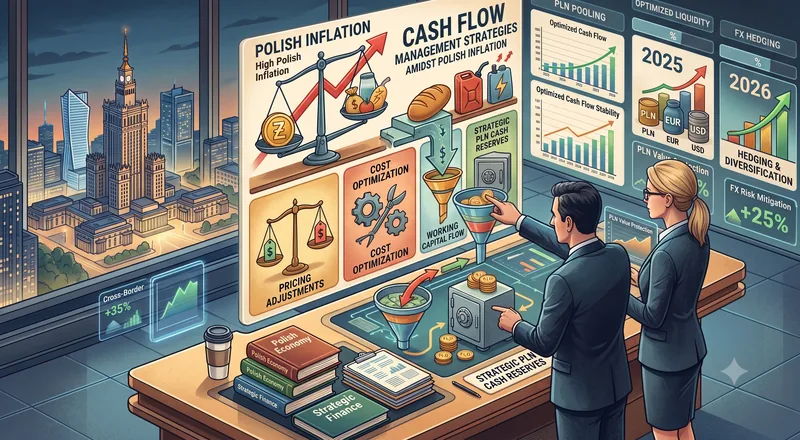
Cash Flow Management Strategies Amidst Polish Inflation
Operating a business in Central and Eastern Europe requires intense financial vigilance. Poland's inflation rate sits at 3.1% as of mid-2026. The National Bank of Poland maintains its reference rate at 3.75%. These macroeconomic conditions squeeze profit margins ruthlessly.
Rising energy costs and geopolitical tensions create a volatile pricing landscape. Corporate leaders face an urgent mandate to optimize liquidity immediately. Inaction guarantees cash depletion.
Suppliers demand faster payments while clients delay their settlements. This mismatch destroys working capital overnight. Financial agility serves as your primary survival mechanism. Implementing aggressive cash management protocols stops the bleeding.
Your treasury department must pivot from passive monitoring to active intervention. Every delayed invoice costs real money in this high-interest environment. Smart capital deployment dictates market leadership. This guide breaks down exact methods to defend your balance sheet.
Robust cash flow management supersedes basic profitability in times of economic strain. A company showing massive paper profits can still go bankrupt if it cannot cover payroll on Friday. You must scrutinize the velocity of money moving through your enterprise. Slow-moving cash cycles strangle growth and invite operational paralysis.
The 2026 fiscal landscape demands proactive treasury management. Gone are the days of cheap capital and relaxed payment schedules. Every chief financial officer operating in Poland today must ruthlessly optimize their working capital metrics. Survival favors those who command their cash flows with military precision.
Hedging PLN against EUR and USD Volatility
Hedging involves using financial instruments like forward contracts to lock in exchange rates for future transactions, protecting your working capital from sudden currency depreciation.
Exchange rate fluctuations decimate anticipated revenues without warning. The Polish Zloty (PLN) frequently experiences sharp volatility against the Euro and US Dollar. In our practice tracking CEE markets, foreign exchange swings wipe out tight profit margins within days. Cross-border operators cannot rely on spot market conversions blindly.
Securing forward contracts eliminates this massive blind spot entirely. A forward contract freezes the exchange rate for a specific future date. You know exactly how much PLN you will receive or pay regardless of market chaos. This certainty allows for precise budget forecasting.
Finance teams can plan capital expenditures without fearing currency crashes. Eliminate the guesswork from your international trade operations. Options contracts provide a highly strategic alternative to strict forwards. They grant the right, but not the obligation, to execute a currency trade at a predetermined price.
Importers facing unpredictable commodity pricing benefit immensely from this flexibility. You protect your downside while retaining the ability to capitalize on favorable market shifts. Consider options a necessary insurance policy. Data from recent corporate setups shows that treasurers who automate their FX hedging reduce currency-related losses by nearly 18%.
Speak with your banking partner about establishing automated threshold triggers. Algorithmic execution removes human emotion from currency trading. Pre-set rules govern your conversions the second the market hits your target rate.
Natural hedging also plays a vital role in currency defense. Align your incoming revenues with your outgoing expenses in the same currency. Invoicing German clients in EUR while paying Spanish suppliers in EUR neutralizes the exchange risk completely.
Accurate cash flow forecasting underpins any successful hedging strategy. You cannot hedge effectively if you do not know your exact foreign currency exposure for the next quarter. Implement rolling 13-week cash forecasts to identify potential currency shortfalls early. Precision data gives your treasury team the ammunition needed to negotiate better forward rates.
Cultivate deep relationships with multiple financial institutions to secure the best FX pricing. Banks charge hidden margins on currency conversions that erode your capital slowly. Pitting two or three banks against each other forces them to offer highly competitive spreads. Aggressive negotiation on banking fees directly bolsters your bottom line.
Shortening Accounts Receivable Cycles in Poland
Shortening accounts receivable means accelerating the speed at which your clients pay their invoices. This strategy directly increases your available daily cash on hand.
Extended payment delays severely constrain corporate liquidity across Poland. You cannot fund daily operations when clients hold onto cash for 60 or 90 days. Polish statutory payment terms often stretch limits, forcing suppliers into tight corners. Implement strict credit control protocols immediately to reclaim your working capital.
Offering early payment discounts changes client behavior instantly. A 2% discount for settling an invoice within 10 days drastically improves collection times. Clients facing the same 3.75% NBP interest rates often jump at guaranteed savings. This simple financial incentive reallocates cash into your accounts much faster.
Punitive measures hold equal importance in your collection strategy. Charge statutory interest on late payments exactly as Polish law permits. Many companies hesitate to penalize clients out of fear of losing business. However, financing your client's operations for free slowly bankrupts your own enterprise.
Establish boundaries clearly in your initial master service agreements. Disputed invoices represent the leading cause of delayed payments in B2B transactions. Clients will use a minor typo as an excuse to hold your money for an extra month. Implement zero-defect invoicing protocols within your billing department.
Triple-check purchase order numbers, entity names, and tax identification numbers before transmitting any document. Transition all clients away from manual bank transfers and toward automated digital payment gateways. Direct debit mandates give you absolute control over the collection timeline.
You pull the funds from the client's account exactly on the due date. Removing the client's finger from the payment button drastically reduces your days sales outstanding.
Leveraging Automated Collection Workflows
Automation eliminates human hesitation in the collections process. Configure your ERP system to dispatch automated reminders three days before an invoice falls due. Follow up relentlessly once an account crosses the deadline. Your assertiveness dictates your place in the client's payment queue.
Assign dedicated accounts receivable specialists to high-risk accounts. Personal phone calls resolve disputes far quicker than automated emails. Train your team to identify stall tactics early in the communication cycle. Rapid escalation to legal demand letters often forces immediate payment from stubborn debtors.
Credit checks must become mandatory for all new Polish clients. Pull detailed reports from domestic credit bureaus before extending any trade credit. Monitor the financial health of your existing clients continuously. A sudden change in their payment behavior signals internal distress that requires your immediate attention.
Utilizing Factoring Services for B2B Invoices
Invoice factoring is a financial transaction where you sell your accounts receivable to a third party at a discount, receiving immediate cash instead of waiting.
Factoring bridges the perilous gap between issuing an invoice and receiving the actual funds. You transfer the default risk and collection burden directly to a specialized financial institution. This aggressive maneuver unlocks trapped capital almost instantly. Companies scale much faster when they stop acting as free banks for their customers.
We consistently see that businesses scaling rapidly rely heavily on non-recourse factoring. This specific setup ensures you keep the cash even if the end client eventually defaults or goes bankrupt. The factor absorbs the total loss under this agreement. Review the fee structures carefully, as Polish factors currently charge premiums aligned with the elevated interest rate environment.
Recourse factoring offers a cheaper alternative but carries significantly more risk. You must buy back the invoice if your client fails to pay within the stipulated timeframe. Use recourse factoring only with highly reputable, blue-chip clients possessing flawless credit histories. Assess your internal risk tolerance before signing any factoring master agreement.
| Factoring Type | Risk of Client Default | Speed of Funding | Typical Cost Factor |
|---|---|---|---|
| Recourse Factoring | Retained by your business | 24-48 hours | Lower base fees |
| Non-Recourse Factoring | Transferred to the factor | 24-48 hours | Higher premium |
| Reverse Factoring | Assumed by the factor | Supplier paid immediately | Supplier bears the cost |
Spot factoring provides an excellent tool for massive, one-off invoices. Instead of locking your entire ledger into a contract, you sell specific high-value invoices individually. This surgical approach minimizes your overall financing costs while injecting massive liquidity bursts when needed. Target your longest-dated receivables for spot factoring.
Treat the factoring fee as an operational insurance premium against insolvency. Selling invoices costs money, but running out of operating cash destroys your entire business structure. Compare rates across at least three different Polish financial institutions. Negotiate the advance rates fiercely to secure up to 90% of the invoice face value upfront.
Modern factoring facilities integrate seamlessly with popular enterprise resource planning software. You do not need to manually upload spreadsheets or physical invoices anymore. API connections transmit invoice data to the factor instantly upon generation. This technological bridge accelerates the funding timeline from days down to mere hours.
Combine factoring with comprehensive trade credit insurance for ultimate protection. While non-recourse factoring covers specific invoices, credit insurance protects your entire ledger against catastrophic client insolvencies. This dual-layered defense mechanism ensures that your business survives even if a major industry player collapses unexpectedly.
Negotiating Payment Terms with Polish Suppliers
Negotiating payment terms involves formally agreeing to extended deadlines for settling your supplier invoices. This process allows you to retain cash longer for operational needs.
Extending your days payable outstanding (DPO) maximizes your internal liquidity dramatically. You should request 60-day or 90-day terms from your Polish vendors whenever market conditions permit. Holding cash in your own corporate accounts acts as a vital buffer against unexpected inflation spikes. Delaying cash outflows represents the simplest form of internal financing.
Use your purchasing power as leverage during every contract negotiation. If you order high volumes consistently, demand better terms during annual renewals. Suppliers usually prefer delayed payments over losing a massive, reliable buyer entirely. Emphasize your stability as a long-term commercial partner in a rocky CEE economy.
Our ongoing analysis of Polish enterprise contracts reveals that strategic buyers rarely accept standard 30-day terms anymore. Procurement teams actively stretch deadlines to match their own collection cycles. You must align your payables with your receivables perfectly. Do not pay your suppliers in 30 days if your clients pay you in 60.
Implementing Phased Supplier Payments
Propose milestone-based settlements for massive inventory orders or capital projects. Breaking a huge invoice into smaller, scheduled payments smooths out your cash outflows over several months. You protect your monthly working capital while keeping the supplier sufficiently funded to continue production.
Leverage reverse factoring, also known as supply chain finance, to satisfy demanding vendors. In this setup, a bank pays your supplier immediately, and you pay the bank later at an extended deadline. The supplier gets their money instantly at a lower discount rate based on your stronger credit profile. Everyone wins in this liquidity triangle.
Consolidate your supplier base to increase your negotiation leverage. Handing a massive contract to a single vendor commands far more respect than scattering tiny orders across ten different companies. Make your business indispensable to their annual revenue targets. Vendors grant the best payment terms to their most critical clients.
If your cash position is exceptionally strong, use it as a weapon to secure massive discounts. Offer to pay a supplier in three days in exchange for a 5% reduction in the total invoice value. Earning a 5% risk-free return in three days outperforms any treasury investment vehicle available. Cash-rich companies dictate the terms of engagement in a tight economy.
Do not tie up cash in dead inventory while negotiating supplier terms. Holding excess stock acts exactly like an uncollected invoice; it traps valuable liquidity. Implement just-in-time inventory systems to align your procurement perfectly with your sales cycle. Storing only what you need frees up cash for more aggressive market expansions.
Frequently Asked Questions (FAQ)
This section provides rapid, definitive answers to the most common queries regarding liquidity management and inflation defense in the Polish market.
What drives the Polish inflation rate in 2026?
The 3.1% inflation rate in 2026 is driven largely by surging energy costs, regional geopolitical instability, and elevated public sector spending. These factors heavily impact supply chains and operating expenses across Central and Eastern Europe.
How does the NBP reference rate affect factoring costs?
The National Bank of Poland's reference rate of 3.75% sets the baseline for domestic lending. Financial factors incorporate this rate directly into their fee structures, making invoice discounting slightly more expensive than in previous low-rate eras.
Are early payment discounts legally binding in Poland?
Yes. Once explicitly stated on the invoice and agreed upon in the commercial contract, early payment discounts are fully enforceable under the Polish Civil Code. They serve as a highly effective tool for accelerating cash inflows.
Which currency should I use to invoice foreign clients?
Always invoice in the currency of your major operational expenses to create a natural hedge. If you pay your primary suppliers in EUR, invoice your international clients in EUR to neutralize foreign exchange risk completely.