
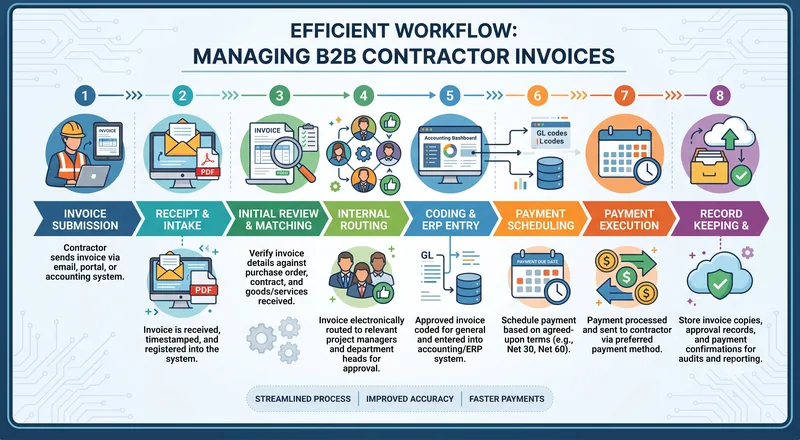
Managing B2B Contractor Invoices: A Workflow for Foreign Employers
Operating across Central and Eastern Europe requires precise financial oversight. Foreign employers contracting local talent must adapt to strict digital mandates. The 2026 regulatory landscape fundamentally alters how cross-border AP teams operate. Managing B2B contractor invoices now demands direct integration with centralized government platforms.
Structuring the B2B Cooperation Agreement
A B2B cooperation agreement dictates the legal, financial, and operational relationship between a foreign employer and an independent contractor. It establishes liability limits, intellectual property transfer terms, and specific invoicing protocols required by regional tax authorities.
Drafting a robust contract serves as the foundation for your entire working relationship. Many foreign entities mistakenly rely on standard employment contract templates. This creates immediate reclassification risks under Polish and CEE labor laws. True business-to-business engagement requires clear separation of control, working hours, and operational subordination.
Your contract must explicitly state that the contractor retains independence over service delivery. Do not dictate exact working hours or provide standard employee hardware without careful legal wording. The contractor operates an independent enterprise. They assume the economic risk for their business decisions and daily operations.
In our practice tracking CEE markets, we consistently see that poorly structured agreements trigger severe tax audits. Tax authorities actively hunt for disguised employment scenarios. Protect your organization by removing clauses that mimic traditional employment benefits. Eliminate paid holiday leaves, sick pay, or mandatory office attendance from the contract text.
Incorporating 2026 Compliance Clauses
The legal text must align directly with the technological reality of 2026. Your agreement should mandate compliance with regional electronic invoicing systems. Contractors must issue documents strictly through the government portal. In Poland, this requires using the exact FA(3) XML schema.
Specify the exact window for invoice submission relative to the end of the billing period. Include explicit language regarding the unique identification numbers assigned by the government platform. Payments should remain legally contingent upon receiving a valid structured invoice. A standard PDF sent via email holds zero legal weight.
The contract must protect the buyer from delays caused by the contractor's tech stack. Outline a clear dispute resolution process for instances where the government API experiences downtime. Establish a protocol for handling offline generation and subsequent system synchronization.
Intellectual Property and Liability
Intellectual property rights do not transfer automatically in a B2B relationship. The agreement must contain a dedicated, explicit assignment clause. Detail the exact moment the rights transfer to your organization. This transfer typically coincides with the full settlement of the respective invoice.
Securing IP protects your core business assets and ensures clean ownership during future due diligence events. Liability caps require equally careful negotiation. Independent contractors should maintain their own professional indemnity insurance. Specify the minimum coverage limits within the cooperation agreement to mitigate financial risk.
Standard market practice limits the contractor's liability to the value of the contract over a 12-month period. You should never cap liability for willful misconduct or gross negligence. Explicitly carve out data breaches and confidentiality violations from any negotiated liability limitations.
Receiving and Validating KSeF Contractor Invoices
Receiving and validating KSeF contractor invoices involves automatically retrieving XML-structured data from Poland’s National e-Invoicing System and verifying the unique KSeF identification number before approving payment.
Poland's Krajowy System e-Faktur (KSeF) enforces a strict clearance model starting in 2026. Every domestic B2B transaction flows directly through Ministry of Finance servers. The government platform validates the logical structure of the document before it officially exists. You no longer wait for contractors to email you a monthly bill.
Your accounts payable system must actively poll the government API to download incoming liabilities. Data from recent corporate setups shows that manual processing breaks down entirely under this framework. Organizations attempting to handle structured XML files without proper software face massive bottlenecks. Your accounting team needs automated workflows to translate raw data into readable formats.
The system must automatically match the incoming KSeF invoice against the corresponding purchase order. It must also verify the contractor's credentials against the national registry. Any failure in this digital handshake halts the payment cycle immediately.
The 2026 Clearance Model Reality
The clearance model eliminates traditional concepts of invoice disputes. Once the government platform assigns the unique KSeF ID, the document enters legal circulation. Buyers cannot simply reject a physical document and ask for a revised copy. Any discrepancy requires the contractor to issue a formal structured correction invoice.
This fundamental shift demands proactive communication before the initial document generation occurs. Foreign employers must establish precise pre-invoicing approval steps. Require contractors to submit a preliminary timesheet or pro forma summary for review. Approve the core amounts before the official KSeF document hits the government servers.
Pre-approval drastically reduces the volume of correction invoices your finance team must process. Corrective workflows consume valuable administrative time and complicate VAT reporting obligations. Clean initial submissions keep your accounting ledgers pristine and predictable.
API Integration and AP Workflows
Direct software connection forms the backbone of modern invoice management. Accounting platforms must securely authenticate with the KSeF environment. Foreign entities frequently struggle with the authorization matrix required to grant software access. You must submit the ZAW-FA form to authorize specific digital tools or accounting partners.
Security protocols demand robust internal controls over API endpoints. Restrict access tokens to authorized personnel and verified IP addresses only. Configure your ERP to flag mathematical discrepancies automatically. If the XML data contains unexpected VAT rates, the system should quarantine the file immediately.
Human operators then review the flagged items against the original B2B agreement. They check the contractor's active status on the Polish White List of VAT taxpayers. Verifying the bank account directly against the government database prevents severe tax penalties.
Handling System Downtime and Offline Modes
Government servers occasionally experience scheduled maintenance or unexpected outages. The 2026 legislation provides specific contingency protocols for these scenarios. Contractors may issue documents in an "offline24" mode during technical failures. They generate a localized document containing a specialized QR code.
Contractors must then upload this offline data to the central system within one business day of service restoration. Your AP processes must accommodate these edge cases without stalling critical contractor payments. Train your team to recognize and process valid QR-coded emergency invoices securely.
Currency Exchange Rate Calculations for VAT
Currency exchange rate calculations for VAT require converting foreign currency amounts to the local currency using the official central bank exchange rate published on the last business day preceding the invoice date.
Cross-border collaborations frequently involve multi-currency payment agreements. A foreign employer might agree to pay a Polish contractor in Euros or US Dollars. Polish tax law demands that the VAT amount strictly appears in Polish Złoty (PLN) on the official invoice. The base net amount can remain in the foreign currency.
The conversion relies on the official mid-rate published by the National Bank of Poland (NBP). The specific rate used depends entirely on the date of service completion or invoice issuance. Getting this calculation wrong triggers immediate discrepancies in the JPK_VAT reporting files. Mismatched tax amounts lead to delayed VAT refunds and potential audits.
Official Conversion Rules in CEE
The standard legal rule dictates using the exchange rate from the last business day before the tax point arises. If the service concludes on a Friday, the calculation utilizes Thursday's official rate. Weekend invoice dates require looking back to the rate published on the preceding Friday.
This rigid formula leaves no room for using corporate monthly average rates or dynamic spot rates. We consistently see that accounting teams relying on manual spreadsheet conversions introduce significant error margins. Copy-pasting rates from financial websites invites catastrophic compliance failures. Precision is mandatory under the digital tax regime.
Automated ERP systems should pull the official central bank rates via daily API feeds. The software then applies the correct historical rate to the specific transaction automatically. This eliminates human error and guarantees absolute alignment with the contractor's submitted tax data.
Comparing Currency Handling Workflows
The following table illustrates the operational differences between manual and automated currency management for B2B invoices.
| Workflow Component | Manual Processing Approach | Automated API Approach (2026 Standard) |
|---|---|---|
| Exchange Rate Sourcing | Finance staff manually checks the central bank website daily. | System automatically fetches official daily rates via bank API. |
| VAT Conversion Calculation | Calculated in spreadsheets, risking formula or date selection errors. | ERP applies exact historical rate based on the legally defined tax point. |
| KSeF Data Matching | Visual comparison of PDF amounts against the internal ledger. | Algorithmic validation of XML fields against system-calculated values. |
| Split Payment Compliance | Manual execution of separate PLN tax transfers via banking portal. | Automated generation of compliant bank transfer files with KSeF IDs. |
Split Payment Mechanisms
Certain industries and transaction values trigger mandatory split payment protocols. When paying an invoice exceeding 15,000 PLN gross that includes specific goods or services, the payment must divide. The net amount travels to the contractor's standard corporate account. The VAT amount routes directly to a dedicated, restricted VAT account.
Foreign employers executing payments from foreign bank accounts face severe friction here. Only Polish bank accounts support the split payment mechanism natively. Operating without a local presence requires careful structuring of cross-border payment flows. You risk denying your own VAT deduction if you bypass the split payment requirement.
You must ensure your banking infrastructure supports the inclusion of the required KSeF reference number. From August 2026, failing to include this number in the payment title violates tax regulations. Work closely with your treasury team to map these routing requirements accurately.
Archiving Requirements for Digital Invoices
Archiving requirements for digital invoices mandate storing structured electronic files in their original XML format for a period of up to 10 years, ensuring unalterable access for tax authority audits.
Proper data retention forms the final pillar of a compliant financial workflow. Tax authorities hold businesses accountable for historical transaction data long after the contractor relationship ends. The transition to centralized e-invoicing systems fundamentally shifts the nature of archiving. You no longer print copies or store disorganized PDFs on shared local network drives.
The KSeF platform acts as the official government repository for ten years. However, relying entirely on the state infrastructure presents massive operational risks. Government portals optimize for tax enforcement, not corporate intelligence or historical spend analysis. You must maintain an independent, secure archive of all XML files retrieved from the central system.
The 10-Year Retention Standard
Digital files must remain readable, authentic, and completely unaltered for a full decade. The XML format guarantees machine readability, but human tax inspectors will require visual representations during an audit. Your archiving solution needs the capability to render historical XML data into clear, standard invoice views instantly.
Tax regulations require seamless access to these archives upon request. If an auditor demands contractor files from four years prior, your team must deliver the precise structured data within days. Slow retrieval times or corrupted files result in immediate financial sanctions. The archive must index files by KSeF ID, contractor tax number, and date of issuance.
Government Repositories vs. Internal Systems
Extracting data from the government platform immediately secures your corporate records. Once downloaded, the files integrate into your broader enterprise resource planning environment. This internal archive feeds directly into your spend analytics, budget forecasting, and contractor performance reviews. It empowers your procurement team with actionable historical data.
Relying solely on KSeF means losing access to your financial history if the government portal experiences downtime. It also complicates matters significantly if you change accounting firms or software providers in the future. An internal repository guarantees business continuity regardless of external factors.
Implement immutable cloud storage solutions that prevent accidental deletion or unauthorized modification. These solutions lock the core financial documents cryptographically. This guarantees mathematical proof of file integrity during subsequent regulatory reviews.
Security and Audit Readiness
Cybersecurity plays a critical role in financial archiving. Contractor invoices contain sensitive pricing structures, personal identification numbers, and banking details. Your storage environment must enforce strict access controls based on the principle of least privilege. Encrypt the data both in transit from the government API and at rest within your corporate servers.
Regular audit drills ensure your team remains prepared for sudden inspections. Test the database retrieval process quarterly. Verify that the stored XML files perfectly match the hash values originally validated by the tax authority. Proactive verification prevents catastrophic discoveries during actual regulatory action.
Frequently Asked Questions (FAQ)
Managing B2B contractor invoices under the 2026 regulatory framework requires strict adherence to centralized e-invoicing mandates, precise currency conversions, and rigorous digital archiving. Review these common questions to clarify compliance steps.
Does KSeF apply to foreign businesses hiring Polish contractors?
Yes. The Polish contractor must issue the invoice through KSeF regardless of the buyer's geographical location. As a foreign employer, you must ensure you have a designated mechanism to receive, validate, and process these structured digital files correctly.
Can we refuse a contractor's PDF invoice in 2026?
Absolutely. A PDF or paper invoice holds no legal validity for transactions mandated under KSeF. You cannot legally process VAT deductions or recognize the corporate cost officially until the contractor generates a valid structured document through the government system.
How do we handle incorrect VAT amounts on a B2B invoice?
You cannot alter the data on your end or simply ask for a deleted and reissued document. The contractor must submit a formal structured correction invoice (faktura korygująca) directly into the KSeF system, referencing the original KSeF identification number assigned to the flawed transaction.
What happens if the government e-invoicing system crashes?
The 2026 regulations permit contractors to issue invoices in an emergency "offline24" mode during verified system failures. They can provide you with the file directly via QR code, but they remain legally obligated to upload it to the central platform within one working day of service restoration.