How to Apply for Binding Rate Information (WIS) in Poland
The Legal Certainty of WIS Rulings
Binding Rate Information (WIS) is an official administrative decision issued by the National Revenue Information (KIS) in Poland. It guarantees absolute legal protection by confirming the correct VAT rate and classification for a specific good, service, or complex supply.
Securing precise tax classification acts as a permanent shield against unpredictable regulatory shifts. The Polish VAT matrix relies heavily on the Combined Nomenclature (CN) for physical goods and the Polish Classification of Goods and Services (PKWiU 2015) for services. Classifying complex products often triggers massive disagreements between foreign taxpayers and regional tax offices. Obtaining a WIS ruling permanently resolves these disputes before they even materialize. It binds all domestic tax authorities strictly to the determined VAT rate across the entire country.
In our practice tracking CEE markets, we consistently see that businesses importing novel goods often face sudden classification disputes upon border entry. Companies bringing innovative electronics, digital health devices, or mixed food supplements into Poland frequently struggle to pinpoint whether an 8% or 23% rate applies. Having a valid WIS effectively removes the ambiguity surrounding the Polish VAT rate matrix. Tax authorities cannot legally challenge the applied rate if the sold item matches the decision's technical description.
The protection extends far beyond just identifying standard rates. Polish law recognizes distinct exemptions alongside preferential rates like 5% for basic groceries or specific printed books. Misapplying a zero-rate or exemption carries severe financial consequences under domestic tax codes. An official ruling provides an absolute defense against retrospective tax assessments during compliance checks. The formal decision outlines the exact classification code and the legal justification, giving corporate financial departments total clarity.
Handling complex supplies presents another massive challenge for modern enterprises. A business seeking to bundle proprietary software with mandatory consulting services needs a definitive answer on treating the combined transaction. The tax authority evaluates whether these elements form a single economic supply or independent services. Securing a ruling on complex supplies eliminates invoicing guesswork entirely. Your accounting department can issue unified invoices without fearing arbitrary reclassification by an aggressive auditor.
Cross-border e-commerce operators face unique vulnerabilities without official classification guidance. Selling identical goods across multiple European jurisdictions often tempts companies to harmonize their VAT rates universally. Polish tax law fiercely rejects this foreign harmonization, demanding strict adherence to local CN mapping. Utilizing the WIS instrument protects foreign sellers from massive domestic tax liabilities.
Preparing the Application and Technical Documentation
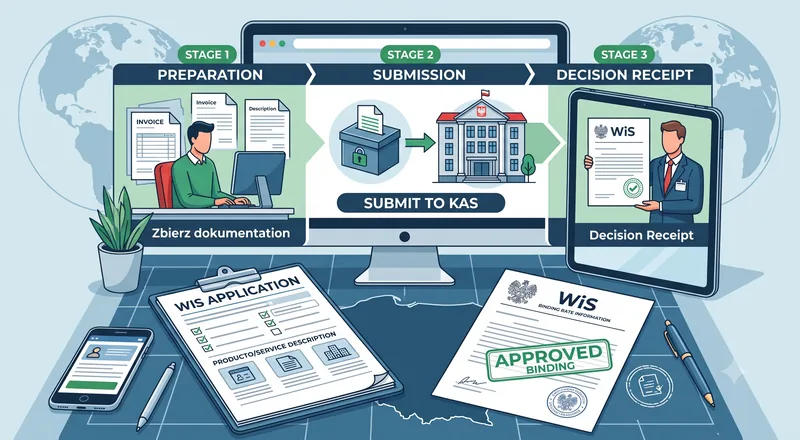
You must submit a WIS application electronically using the e-Urząd Skarbowy (e-Tax Office) portal. The filing requires a precise factual description of the transaction and technical documentation supporting the product's requested classification.
Initiating the legal process requires active access to the government's digital tax infrastructure. Polish tax administration mandated fully digital submissions for these exact rulings to streamline backend processing. Submitting paper forms or utilizing the older e-PUAP system leads to automatic rejection without any substantive review. Applicants log into the e-Urząd Skarbowy platform using their trusted profile or a qualified electronic signature. The interactive electronic form guides corporate users through all mandatory fields seamlessly.
Data from recent corporate setups shows that authorities frequently reject vague applications almost immediately. Providing comprehensive technical specifications upfront drastically reduces the chance of additional summons for evidence. You should attach high-quality photographs, detailed engineering schematics, and official manufacturer catalogs directly to the digital submission. If a specific product contains multiple raw ingredients, a precise percentage breakdown remains strictly mandatory. KIS officials rely heavily on these minute details to assign the legally binding CN code.
Complex digital services demand a completely different type of evidentiary support. Contractual agreements, detailed scopes of work, and service delivery protocols serve as the critical foundation for evaluating PKWiU classifications. Describing the exact mechanics of the service delivery allows the assessing officer to grasp the true commercial reality. Ambiguity here often prompts the authority to request supplementary information via a formal administrative letter. You have a strict seven-day calendar window to upload your response through the portal.
Sometimes, documentary evidence fails to paint a complete or accurate picture. The assessing organ holds the statutory right to demand physical samples of the tangible good in question. Sending these physical items to specialized National Revenue Administration (KAS) laboratories allows government chemists to verify the declared composition. Securing a favorable outcome heavily depends on absolute transparency during this crucial submission phase. Misrepresenting a product immediately voids any future legal protection granted by the decision.
Translating technical documentation into professional Polish forms an absolute requirement for successful submissions. Foreign parent companies frequently attempt to submit original English manuals or generic marketing brochures. The KIS assessing officers possess the right to ignore any non-Polish technical specifications entirely. Providing certified translations of the core operational mechanics guarantees the assessing officer interprets the facts correctly.
Foreign entities must prepare properly before clicking submit. You need an active Polish Tax Identification Number (NIP) to register an account within the e-Urząd Skarbowy system. Companies merely planning to expand into Poland can still apply, provided they intend to perform taxable activities locally. Assigning a local tax proxy simplifies this digital hurdle immensely. The proxy handles the secure uploads and monitors the portal daily for incoming administrative correspondence.
Timelines and Costs for Tax Office Decisions
The standard statutory processing time for a WIS decision spans up to three months from the submission date. The base application is entirely free of charge, though additional specialized lab analyses may incur mandatory fees.
Navigating the financial aspects of the procedure reveals a highly accessible regulatory system. Since mid-2023, the Polish Ministry of Finance permanently abolished the standard baseline fee for submitting these specific classification requests. The zero-cost entry removes a massive financial barrier for small and medium enterprises seeking fiscal security in 2026. Acting through a legal proxy requires a standard stamp duty of 17 PLN for the official power of attorney. This minimal administrative cost remains the only guaranteed expense for standard corporate applicants.
Exceptions to the free processing rule do exist under strict conditions. Tax authorities sometimes mandate specialized laboratory tests to verify a product's precise chemical makeup or physical properties. These independent evaluations happen exclusively at accredited KAS laboratories or the Polish Academy of Sciences. When this occurs, the authority issues an official summons demanding a specific advance payment to cover the testing expenses. Failing to transfer this exact fee to the KIS bank account halts the entire application instantly.
The statutory three-month waiting period sets a clear horizon for enterprise resource planning. This exact timeframe pauses whenever the tax office issues a formal request for supplementary documents or orders laboratory tests. Promptly delivering the requested data through the e-Urząd Skarbowy portal ensures the clock resumes quickly. Businesses launching new product lines must build this evaluation period directly into their regional market entry strategies.
Applicants maintain the right to withdraw their submission at any point before the final ruling issuance. A company might discover a flaw in their technical documentation or shift their strategic business model mid-process. Withdrawing the request closes the administrative file immediately without issuing a binding decision. This strategic retreat allows the business to regroup and file a perfect application later without prejudice.
If the administration issues an unfavorable classification, you possess clear appellate rights. The applicant holds 14 days to file a formal appeal against the Director of KIS. This appeal must also flow through the identical digital portal using the dedicated "Pismo w sprawie WIS" module. Should the internal appeal fail, you can escalate the dispute to the Provincial Administrative Court (WSA).
Comparing Tax Rulings
Understanding the differences between available administrative instruments optimizes your legal strategy. Many foreign investors confuse general interpretations with specific rate parameters.
| Legal Feature | Binding Rate Information (WIS) | Individual Tax Ruling (Interpretacja) |
|---|---|---|
| Base Application Fee | 0 PLN (excluding lab test costs) | 40 PLN per specific legal question |
| Mandatory Submission Method | Strictly e-Urząd Skarbowy | e-Urząd Skarbowy, e-PUAP, or Paper Mail |
| Primary Legal Scope | VAT rates, exact CN/PKWiU classifications | Broad interpretations of general tax law |
| Level of Binding Effect | Strictly binds all tax organs nationwide | Protects only the specific applicant |
| Standard Validity Period | Exactly 5 years from the issue date | Valid indefinitely until regulations change |
Using WIS to Mitigate Future Audit Risks
A valid WIS ruling binds tax authorities strictly to the stated VAT rate for your specific transaction. It nullifies the risk of penalty interest or severe penal-fiscal sanctions during future compliance audits.
Deploying a confirmed legal classification transforms how your accounting department handles daily financial operations. Polish tax audits scrutinize corporate VAT settlements intensely, often challenging borderline consumer products. Presenting a formal decision immediately halts any theoretical debate over the correct statutory rate. The field inspector must respect the KIS document blindly, shifting the audit's focus away from subjective classification disputes. This absolute protection shields the company from devastating back-tax calculations.
We consistently see that companies holding valid WIS decisions bypass prolonged arguments during standard VAT inspections. Data matching between the National e-Invoicing System (KSeF) and submitted SAF-T (JPK_VAT) files triggers automated red flags if irregular rates appear. New reporting rules active from February 2026 mandate strict documentary codes like "OFF" or "BFK" for specific commercial transactions. Having a ruling ensures your backend ERP systems apply the flawless logic required to satisfy these automated checks safely.
The legal shield provided by the decision demands strict adherence to the originally declared facts. Modifying a product's chemical formula or changing a service's underlying delivery method subtly alters the commercial reality. When the actual transaction diverges from the precise scenario described in the original application, the administrative protection vanishes instantly. Businesses must regularly audit their active product lines against their existing historical rulings. Any significant material modification requires filing a completely new request to maintain operational security.
Holding a confirmed classification also accelerates mandatory VAT refund procedures significantly. Regional tax offices routinely freeze large refund claims while investigating the underlying transactional logic. Presenting the official ruling document during these preliminary checks eliminates the inspector's legal basis for extended delays. Your accounting department regains control over corporate cash flow much faster.
Holding a valid ruling protects specifically against the Fiscal Penal Code (KKS). Tax officers utilize KKS provisions to impose heavy personal fines on company directors for blatant VAT underpayments. Even if an auditor successfully challenges a classification due to a minor factual discrepancy, possessing an honest WIS demonstrates profound corporate diligence. This documented good faith directly blocks the intent required to prosecute criminal fiscal negligence.
Relying on another taxpayer's published ruling offers an alternative, albeit riskier, compliance strategy. Polish legislation allows you to benefit from a decision issued to a direct competitor, provided your commercial product is perfectly identical. Proving absolute material identity during a hostile audit falls entirely on your corporate shoulders. Securing your own personalized document remains the absolute gold standard for bulletproof fiscal safety in Poland.
Frequently Asked Questions (FAQ)
Below are specific answers regarding the application process, protections, and valid timeframes for Binding Rate Information rulings in Poland.
What is the official fee for a WIS application in Poland?
The basic administrative application is completely free of charge. You only pay additional hard costs if the tax authority requires specialized laboratory testing or physical sample analysis to determine the precise classification.
How long does a WIS ruling remain valid?
A formal decision generally remains valid for exactly five years from the official date of issue. The legal protection expires earlier if the underlying VAT legislative acts or the official classification nomenclature changes significantly.
Can I submit a WIS application on paper?
No. Polish tax authorities strictly mandate electronic submissions via the official e-Urząd Skarbowy portal. Sending paper forms or routing submissions through the older e-PUAP system will trigger automatic rejection.
Does a WIS ruling protect other taxpayers?
Yes. While formally issued to a single distinct applicant, another taxpayer selling identical goods or services can legally rely on that public ruling. This tactic secures similar baseline protection against aggressive tax penalties.